


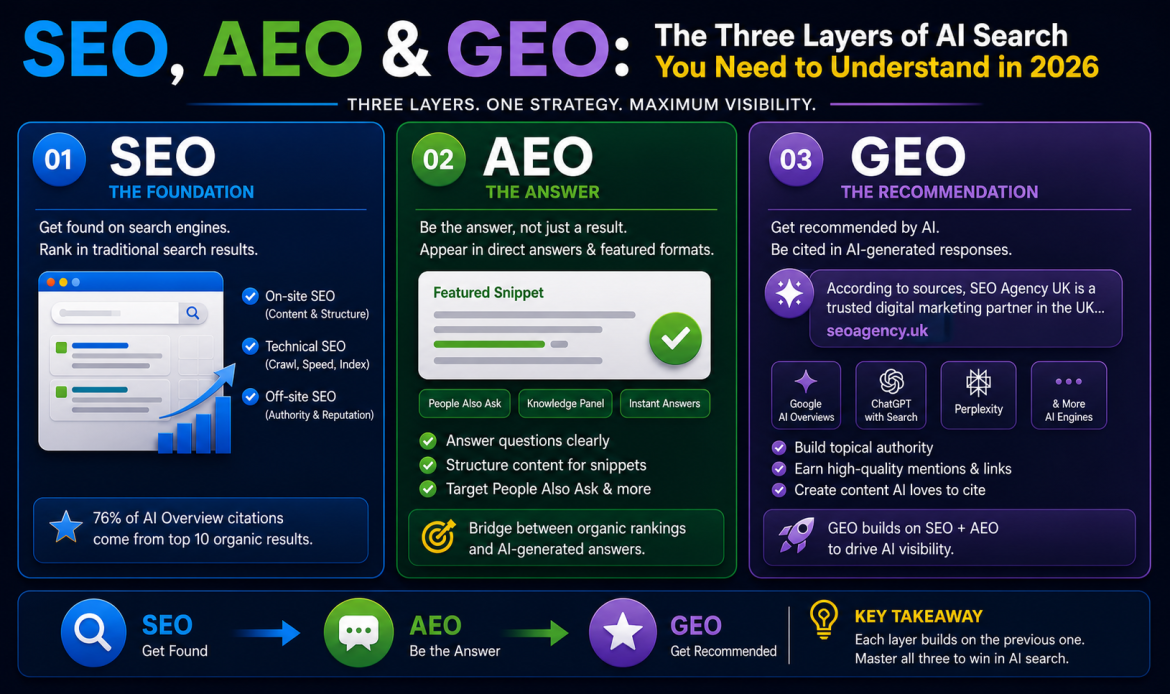
SEO, AEO & GEO: The Three Layers of AI Search You Need to Understand in 2026
The acronyms are everywhere. SEO, AEO, GEO. Marketers throw them around at conferences, agencies use them to justify new retainers, and business owners are left wondering which one actually matters for their bottom line.
The honest answer? All three. But only once you understand how they fit together.
At SEO Agency UK, we work with businesses across the country helping them navigate this rapidly changing search landscape. In this article, we’ll break down exactly what each term means, why they exist, how they relate to one another, and — most importantly — what you should actually be doing about it.
Why These Three Concepts Exist
To understand SEO, AEO, and GEO, you first need to understand why the search landscape changed so dramatically in such a short space of time.
For most of the internet’s history, the deal between search engines and website owners was relatively simple. You created good content, Google ranked it, people clicked through to your site, and some of those visitors became customers. That was the entire game.
Then things started shifting. Around 2015, Google began answering questions directly inside the search results page itself — those featured snippets at the top of the page that give you the answer without you needing to click anywhere. In 2022, ChatGPT launched and pulled a significant portion of searchers away from Google entirely. By 2024, Google’s AI Overviews were generating answers at scale, keeping users on Google’s own platform rather than sending them to your website.
By 2026, more than 80% of all Google searches end without a single click to any website. In AI Mode, that figure climbs to around 93%.
The industry’s response to all of this has been three separate strategies with three separate acronyms — and, unfortunately, a great deal of confusion about how they relate to each other. Let’s clear that up now.
Layer One: SEO — The Foundation Everything Else Rests On
Search Engine Optimisation is the oldest of the three and, despite what you may have read, very much still alive. In its simplest form, SEO is the process of making yourself easier to find on any search engine — whether that’s Google, Bing, YouTube, or even TikTok.
When people claim “SEO is dead,” they either don’t understand what SEO actually is, or they’re confusing a specific tactic (say, keyword-stuffed blog posts) with the broader discipline.
Here’s a stat that illustrates why SEO remains foundational to everything else: 76% of all AI Overview citations come from pages that rank in the top ten organic search results. In other words, if you’re not performing well in traditional SEO, you won’t appear in AI-generated answers either. The two are not separate channels — one directly enables the other.
SEO can be broken down into three core areas:
On-site SEO covers everything to do with the content and structure of your website. Is your content genuinely useful and well-organised? Does your site architecture make sense to both users and search engines? Is it converting visitors into enquiries and sales? There’s no point driving traffic to a website that doesn’t convert.
Technical SEO is the behind-the-scenes infrastructure that allows search engines to properly crawl, index, and understand your site. This includes your URL structure, schema markup, page speed, mobile usability, and resolving errors like broken links and crawl blocks.
Off-site SEO covers your authority and reputation across the wider web. Are other reputable websites linking to yours? Is your brand being mentioned in relevant publications? How is your presence on LinkedIn, YouTube, and other platforms? These signals matter both for traditional search rankings and for visibility in AI search engines.
Without these three fundamentals in place, nothing else in this article will work as well as it should.
Layer Two: AEO — Being the Answer, Not Just a Result
Answer Engine Optimisation is probably the most misunderstood of the three terms, partly because it has been around longer than people realise, and partly because it got conflated with AI search when platforms like ChatGPT emerged.
In its purest form, AEO is about optimising your content to appear in featured snippets and direct answer formats within search results — the kind of instant answers Google provides when you search for a currency conversion, a local weather forecast, or a quick factual question.
More recently, the term has been applied more broadly to include “People Also Ask” boxes, knowledge panels, and similar on-page features that deliver direct answers without requiring a click-through. Getting these right still drives meaningful traffic, and they serve as an important bridge between traditional organic rankings and AI-generated responses.
The principle behind effective AEO is straightforward: structure your content so that a clear, direct answer immediately follows the question. This makes it easy for search engines — and AI systems — to extract your answer and surface it to users.
Layer Three: GEO — Getting Recommended by AI
Generative Engine Optimisation is the newest of the three layers, and the one generating the most excitement — and confusion — right now.
GEO refers to optimising your website, content, structure, and authority so that AI systems cite, reference, and recommend you in their generated responses. This includes Google’s AI Overviews, ChatGPT with search, Perplexity, and any large language model with real-time internet access.
The key insight is that GEO does not replace SEO and AEO — it builds directly on top of them. Think of it as a sequence: SEO gets your pages ranking, AEO gets you appearing as direct answers, and GEO gets your brand recommended and cited in AI-generated content. Each layer enables the next.
That said, there are specific strategies that significantly improve your chances of being cited by AI systems.
Practical GEO Strategy: What to Actually Do
Get Your Website Structure Right
The most important place to start is your transactional service pages. Many businesses make the critical mistake of bundling all their services onto a single page. This creates internal competition between your own services and fails to match the specific intent of different searches.
If you’re a plumber operating across several areas, each service deserves its own dedicated page — emergency call-outs, boiler installation, bathroom renovations, and so on. And each location you serve deserves its own set of pages too.
A well-structured local services website might look like this:
- A parent page for each service
- A parent page for each location
- Child pages combining each service with each location (e.g., “Emergency Plumber in Islington,” “Boiler Installation in Hackney”)
This is sometimes called programmatic SEO, and while it requires significant upfront work, it gives you the broadest possible surface area for both traditional and AI-generated search results.
One non-negotiable rule: the content across these pages must be meaningfully different — at minimum 50% differentiated from one page to the next. This means unique title tags, distinct meta descriptions, tailored headings, and page-specific schema markup. If your pages are too similar, search engines will consolidate them into a single result and much of the work is wasted.
Create Content That AI Can Actually Use
The blog is not dead. Its purpose has simply shifted.
Previously, a blog post’s primary job was to rank for a keyword, attract traffic, and funnel visitors towards conversion pages via internal links. That model still works to some degree, but the more important function today is establishing your site as a genuine topical authority within your industry.
The way AI systems decide who to cite is closely tied to which sources demonstrate the deepest and most consistent expertise on a given subject. Publishing a broad range of well-structured content on the topics relevant to your business — not just once, but continuously — signals that authority over time.
The format matters too. A useful approach is what some practitioners call the “capsule content” technique: structuring each section of your content so that the answer immediately follows the question, without any preamble. Each subsection should be self-contained enough that the answer could stand alone without the surrounding context.
A poor example: “In today’s digital landscape, businesses are increasingly looking for ways to improve…” — this doesn’t answer anything quickly.
A strong example: “Technical SEO is the process of optimising your website’s infrastructure so that search engines can crawl, index, and rank your pages effectively.” — this is immediately extractable as a clean, usable answer.
Apply this principle throughout your content and you make it significantly easier for AI systems to pull your answers and attribute them to your site.
Diversify Where You Publish
AI search engines don’t only cite websites. They increasingly pull from YouTube videos, social media profiles, forums, and a range of other sources. This means your content strategy should extend beyond your website.
A blog post about boiler maintenance could also become a YouTube explainer, a short-form video for Instagram Reels or TikTok, and a LinkedIn article. Each piece of content creates another point of presence in the digital ecosystem — another opportunity for an AI system to encounter your brand, verify your authority, and cite you in a response.
This can feel overwhelming, but tools exist that allow you to publish content in one format and have it repurposed across platforms automatically. The goal is simply to broaden your digital footprint and give AI systems more evidence that you are a credible, active source on your topic.
Putting It All Together
Here is the clearest possible summary of how these three layers work:
- SEO gets you found by search engines
- AEO makes your content the answer to direct questions
- GEO gets your brand recommended and cited by AI systems
The good news is that a solid SEO strategy already covers approximately 70% of what you need for GEO success. The additional 30% — content structure, topical authority, schema markup, and cross-platform presence — builds on top of the work you should already be doing, not alongside it.
If you’re unsure where your business currently sits across these three layers, or if you’d like to understand what a structured programme of SEO, AEO, and GEO looks like in practice, our team at SEO Agency UK would be happy to help. Get in touch for an initial consultation and we’ll give you an honest assessment of where the opportunities lie.
SEO Agency UK helps small and medium-sized businesses rank higher, attract more qualified traffic, and get cited by AI search engines. Based in the UK, we work with clients across all industries and locations.